
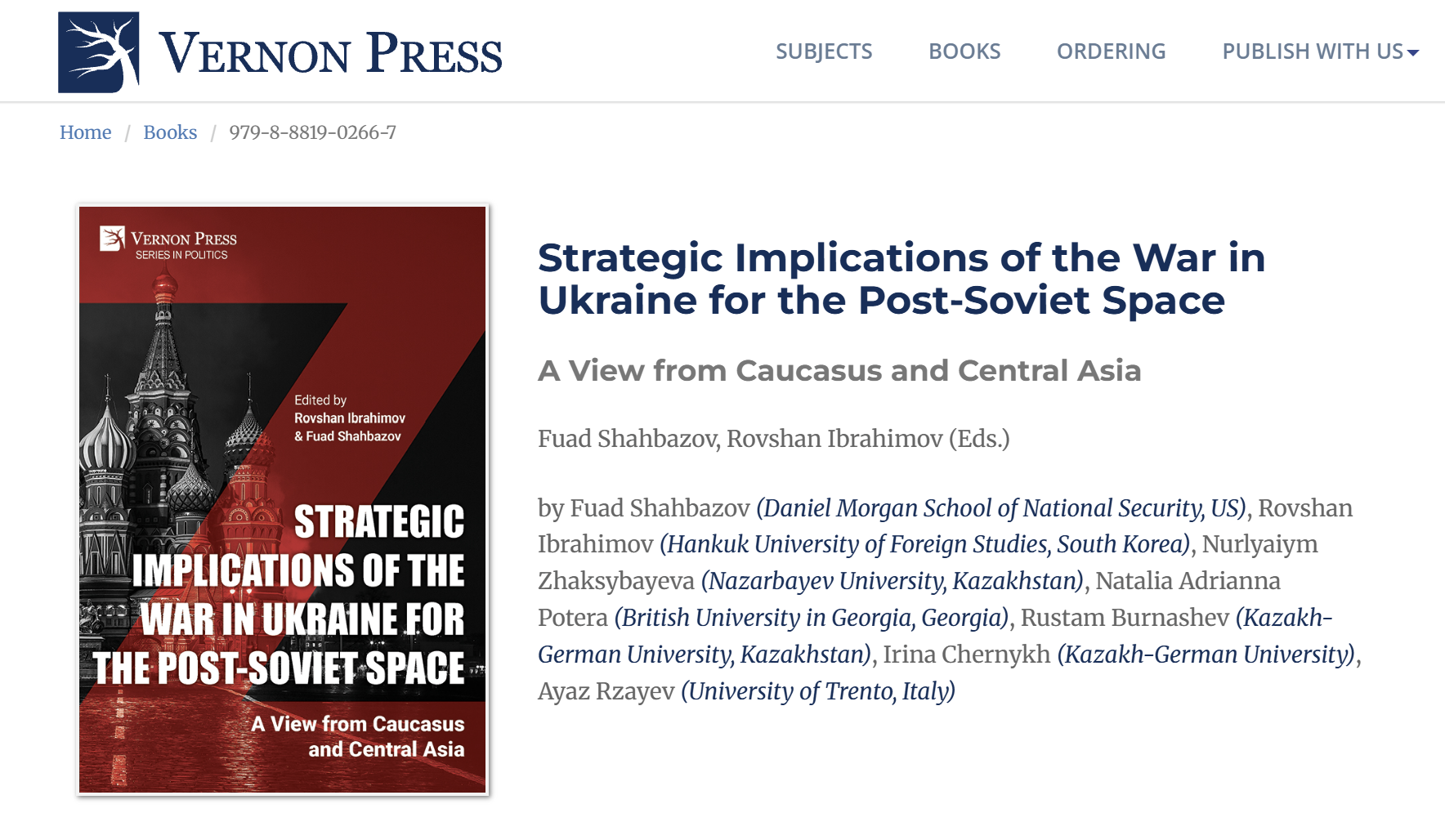
A View from Caucasus and Central Asia
This groundbreaking volume offers an in-depth exploration of how Russia’s 2022 invasion of Ukraine has reshaped the geopolitical landscape of the post-Soviet space, particularly in the Caucasus and Central Asia. Through expert analyses, the book examines the far-reaching consequences of the war, including shifts in regional alliances, energy security dynamics, the rise of new cooperation platforms, and the growing role of external actors such as China and Turkey.
Through rigorous analysis, the book explores critical themes, including the shifting balance of power in the region, the re-emergence of the Organization of Turkic States, Azerbaijan’s deepening engagement with Central Asia, Kazakhstan’s strategic repositioning, and the complex interplay among Russia, China, Turkey, and the West. It also examines how regional actors are adapting to economic disruptions, energy security challenges, and evolving diplomatic alliances. Blending academic depth with policy relevance, “Strategic Implications of the War in Ukraine for the Post-Soviet Space” is an essential resource for scholars, analysts, and professionals in international relations, security studies, and Eurasian affairs.
On September 27, 2020, the South Caucasus region witnessed a new round of full-scale war between Azerbaijan and Armenia. During the 44-day-long war, the pro-war sentiments in Azerbaijani and Armenian societies sharply increased as their confidence in a full victory. This article examines the main causes of the Second Karabakh War by considering the traditional balance of power in the South Caucasus. It asserts that the long-term peace negotiations between the warring parties to resolve the protracted conflict through dialogue also played a crucial role in the occurrence of a full-scale war. The research hypothesis is that the Second Karabakh War significantly altered the regional security architecture and abruptly reshaped the geopolitical configuration of the South Caucasus.
Chapter 4
Changing Regional Balance of Power in the South Caucasus Chessboard
This book presents a fresh perspective on the geopolitics of Central Asia by shifting attention from great powers such as Russia, China, and the United States to the growing role of small and middle powers. It examines how states, including South Korea, Japan, Turkey, Iran, Israel, Azerbaijan, Georgia, Pakistan, India, Brazil, Argentina, Mexico, Gulf countries, and Southeast Asian nations, interact with the region through economic cooperation, security ties, and cultural diplomacy. By analyzing these often-overlooked actors, the volume fills a critical gap in international relations and Central Asian studies. It highlights how smaller states shape regional stability, economic growth, and geopolitical competition while adopting strategies that reflect both opportunities and constraints. Bringing together leading scholars from multiple disciplines, the book offers valuable insights into foreign policy, economic initiatives, and soft power engagement. It will serve as an essential resource for scholars, policymakers, and students seeking to understand Central Asia’s evolving dynamics.
Chapter: Azerbaijan’s Pragmatism: Navigating Foreign Policy in a Fragmented World
This book is an academic study aiming to comprehensively analyze Middle Eastern Studies. Each chapter provides a detailed and analytical examination of regional developments. The Middle East is a region characterized not only by conflicts and disputes but also by rapid economic development and social transformation. Understanding the Middle East is crucial for observing the fundamental parameters of global politics.
Chapter: Proxy warfare recalibrated: Iran’s decentralized proxy strategy in the new regional order