
Executive Summary:
- Iranian Foreign Minister Abbas Araghchi met with Russian President Vladimir Putin in St. Petersburg on April 27 about the ongoing conflict in and around Iran. The visit highlighted the two states’ Comprehensive Strategic Partnership Treaty, signed in January 2025.
- Russia has reaped some economic benefits from Iran’s closure of the Strait of Hormuz, which raised oil demand and prices and caused the United States to ease sanctions on Russian oil already at sea. If Moscow shows robust military support for Iran, however, it risks damaging economic and diplomatic ties with other Gulf states.
- Russia is constrained from acting as a main mediator in the Iran conflict due to its war against Ukraine. The Iran conflict also endangers key trade corridors, including the International North–South Transport Corridor (INSTC), which links Russia and Iran via the Caucasus.
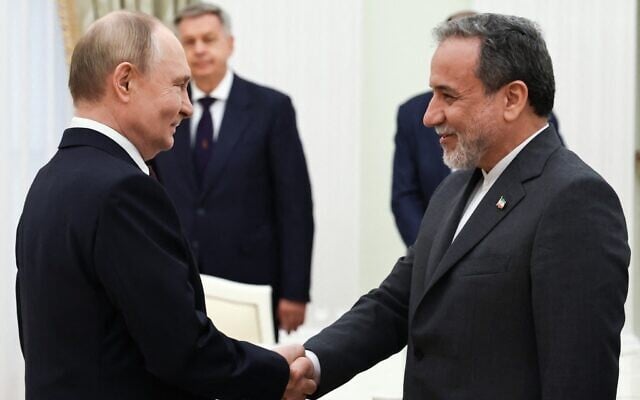
Iranian Foreign Minister Abbas Araghchi met Russian President Vladimir Putin in St. Petersburg on April 27 to discuss the ongoing conflict in and around Iran (The Moscow Times; Interfax, April 27). Araghchi’s visit to Moscow highlighted the two states’ Comprehensive Strategic Partnership Treaty—which Putin and Iranian President Masoud Pezeshkian signed in January 2025—and raised questions about how Moscow benefits from the ongoing conflict between the United States and Iran (President of Russia, April 21, 2025). During the meeting, Putin praised the Iranian people for “fighting for their independence and sovereignty” (President of Russia, April 27). Moscow aims to secure benefits from the Hormuz Strait crisis to gain additional leverage in negotiations on its war against Ukraine.
Russia’s support for Iran could sour its relations with wealthy Gulf monarchies. Russia has sought to benefit from the conflict between the United States, Israel, and Iran that began on February 28, particularly following the closure of the Strait of Hormuz (Anadolu Ajansı, June 5). Iran’s decision to close the strait by planting naval mines, deploying coastal missile batteries, and drone swarms surged global energy prices, causing mid-term disruption of the supply chain (see EDM, March 16). Moscow has viewed Tehran as its main ally in the Middle East for many years, providing military and financial assistance amid long-term international sanctions.
The conflict in Iran disrupted international crude oil trade, triggering fuel shortages in the Asian market. Russia has benefited from this shortage, which has increased demand for its oil and gas. After pressure from Asian countries, the United States opted to ease sanctions on Moscow’s seaborne oil exports as of March 12, allowing purchases of Russian oil that are stranded on tankers at sea (Meduza, March 13). Washington intended the move to mitigate global energy price spikes. Russia was able to take advantage of increased oil demand and eased sanctions by selling down some of the 140 million barrels of oil stranded at sea due to sanctions.
Russia fears that a protracted conflict will jeopardize key projects in Iran. Among them are the Bushehr nuclear power plant, which has been repeatedly struck during the conflict, the Sirik thermal power station, and the ZN Vostok initiatives aimed at developing Iranian oil fields (Vedemosti, March 14, 2018; Russiri.ru, June 10, 2021; Profile.ru, April 9; RBC, April 14). Equally concerning is the disruption of the International North–South Transport Corridor (INSTC), the principal trade artery linking Moscow and Tehran through the South Caucasus, whose functionality is now at risk. Russia has occasionally attempted to act as a mediator in the Iran conflict, while also seeking to secure economic and political benefits from it (TASS, April 1). Given its partnership with Iran and ongoing war against Ukraine, however, Moscow was not seriously considered as the key intermediary.
Moscow’s war against Ukraine prevents it from mediating other peace processes. Moscow may seek to supply Iran with more weaponry, namely MANPADs and one-way drones, in addition to providing targeting intelligence for Iranian missiles and drones (IST, April 24). Russia’s close ties with Iran’s political establishment, particularly the senior leadership of the Islamic Revolutionary Guard Corps (IRGC), allow the Kremlin to attempt to position itself as a diplomatic channel between the other Gulf states and Tehran amid Iranian strikes on their energy and military infrastructure. On February 28, Russian Foreign Minister Sergei Lavrov held a call with Qatari Prime Minister Mohammed bin Abdulrahman bin Jassim Al Thani regarding the U.S.–Israeli Operation Epic Fury (Ministry of Foreign Affairs of Russia, February 2). In the following days, Putin held calls with the leaders of Bahrain, Qatar, the United Arab Emirates (UAE), and Saudi Arabia, and Lavrov spoke with Oman’s foreign minister.
Moscow is no longer positioning itself as a primary mediator in the Iran conflict. On May 18, Lavrov stated that Moscow is “not trying to enter this negotiation process,” adding that it does not try to interfere with the process between the United States and Iran and wishes it success (RT, May 18). Russia remains hesitant to provide robust military support to the Iranian regime as it struggles in its war against Ukraine. Such a restrained posture, especially considering Putin’s failure to assist partners in Syria and Venezuela meaningfully, may further delegitimize Moscow’s promises to its other partners (see EDM, April 6).
Russia recognizes Iran’s value as a partner and hopes to preserve its role within broader geopolitics. Iran’s ideological and political importance to Russia, however, does not outweigh the strategic value of the wealthy Gulf states, given Moscow’s existing infrastructure projects and economic agreements with them. For instance, on May 12, Saudi Arabia and Russia elevated their partnership by introducing a visa-free regime for up to 90 days, a step designed to deepen economic cooperation and expand mutual tourism (Asharq Al-Awsat, May 12). Trade between the UAE and Russia is more than double that between Russia and Iran (Riddle, April 24). The Iran conflict poses challenges for Moscow, disrupting regional trade and energy infrastructure and forcing it to make risky calculations in a changeable regional environment.