Tensions between Azerbaijan and Iran have grown rather raw recently in the wake of Baku’s inauguration of its first-ever embassy in Israel. Of course, diplomatic relations between the neighbours have steadily become more and more inflamed and embittered for several years now, with Iran concerned at the declining influence in the South Caucasus it has suffered since the second Karabakh war between Azerbaijan, urged on by Turkey, and Armenia in late 2020. And with the normalisation of diplomatic ties between Tehran and Baku unlikely in the near future, the big question remains unanswered: Is it possible that the tensions could escalate into a large-scale regional conflict?
Over the past 18 months, tensions have gradually continued to escalate between Azerbaijan and Iran. Ties have been strained by a combination of diplomatic spats and military drills along their border. Azerbaijan perceives Iran as posturing dangerously towards its southern regions, while Tehran is threatened by Baku drawing closer to the Islamic Republic’s regional rivals—particularly Israel. Absent a change in these dynamics, relations could further deteriorate, with tensions boiling over.
The end of 2022 marked another round of confrontation between Azerbaijan and Armenia in the Karabakh region with the involvement of Russian peacekeeping forces. The standoff began in early December, when the Russian peacekeeping contingent in the separatist Karabakh region denied access to Azerbaijani officials from the Ministry of Economy, Ministry of Ecology and Natural Resources and the state-owned mining company AzerGold CJSC from carrying out on-site inspections of the Gizilbulag gold deposits and the Demirli copper-molybdenum deposits to evaluate potential risks to the environment (Mfa.gov.az, December 13, 2022; Fed.az, December 16, 2022). While Azerbaijani state officials were deprived of free movement inside the separatist portion of Karabakh by the peacekeeping mission, it fueled scepticism in Azerbaijani and Armenian societies regarding Russia’s role in the process (Eurasianet, December 15, 2022).
The recent war of words between Azerbaijan and Armenia, and the developments of the last several weeks, have demonstrated that both sides are far from inking a peace deal, which was promised by the end of 2022. Although both states vowed to intensify joint efforts on the final peace treaty in October 2022 on the sidelines of the Prague summit, little has been done since. On the contrary, the failure to hold peace negotiations has been magnified by Russian President Vladimir Putin’s controversial statements regarding Moscow’s non-recognition of Azerbaijan’s sovereignty over Karabakh, which have immensely increased the risks of renewed hostilities between Baku and Yerevan (JAM-news, October 28). Although Russia maintains the role of “key mediator” on the Karabakh issue, Azerbaijan now openly demonstrates its discontent over Moscow’s role in the peace process, particularly after the merely symbolic meeting in Sochi on October 3 (Apa.az, November 28).
On October 5, 2020, when the full-scale war between Azerbaijani and Armenian armed forces had just started in and around Nagorno-Karabakh, President Ilham Aliyev was already talking about military reform. In an interview with Turkish state-run broadcaster TRT, Aliyev said that his intention was to remake the Azerbaijani military “based on the Turkish model but on a smaller scale.”
That reform had been underway for several years as Azerbaijan sought to move away from a Soviet model of the armed forces – featuring a heavy use of conscripts and large quantities of infantry and armor units – toward a more NATO-style professional, mobile, high-tech force. As Turkey was Azerbaijan’s closest ally, it was naturally the NATO military Baku sought to emulate.
Turkey’s heavy military support to Azerbaijan in the war against Armenia solidified that orientation. As Aliyev put it in the interview: “Turkey’s moral support and the Turkish defense industry products at our disposal strengthen us, and the whole world can see that. The Turkish Army is the second strongest army in NATO today, and no one can confront it.”
Different interpretations of the 10 November 2020 trilateral declaration which ended the 44 day Karabakh war resulted in an open sharp exchange between the Azerbaijani Ministry of Defence and its Russian counterpart. “The Azerbaijani leadership is not in the mood to consider any concessions when it comes to the country’s territorial integrity”, writes Fuad Shahbazov in this op-ed for KarabakhSpace.eu.
More than a year after the signing of the 10 November ceasefire agreement between Azerbaijan and Armenia tensions in the Karabakh region again flared up in the last days, causing another round of war of words between Azerbaijan and Russia. The current discontent between Baku and Moscow seems more significant compared to August of 2021 when official Baku openly accused the Russian peace contingent in Karabakh of inaction while elements of the Armenian Armed Forces were transferred to this region.
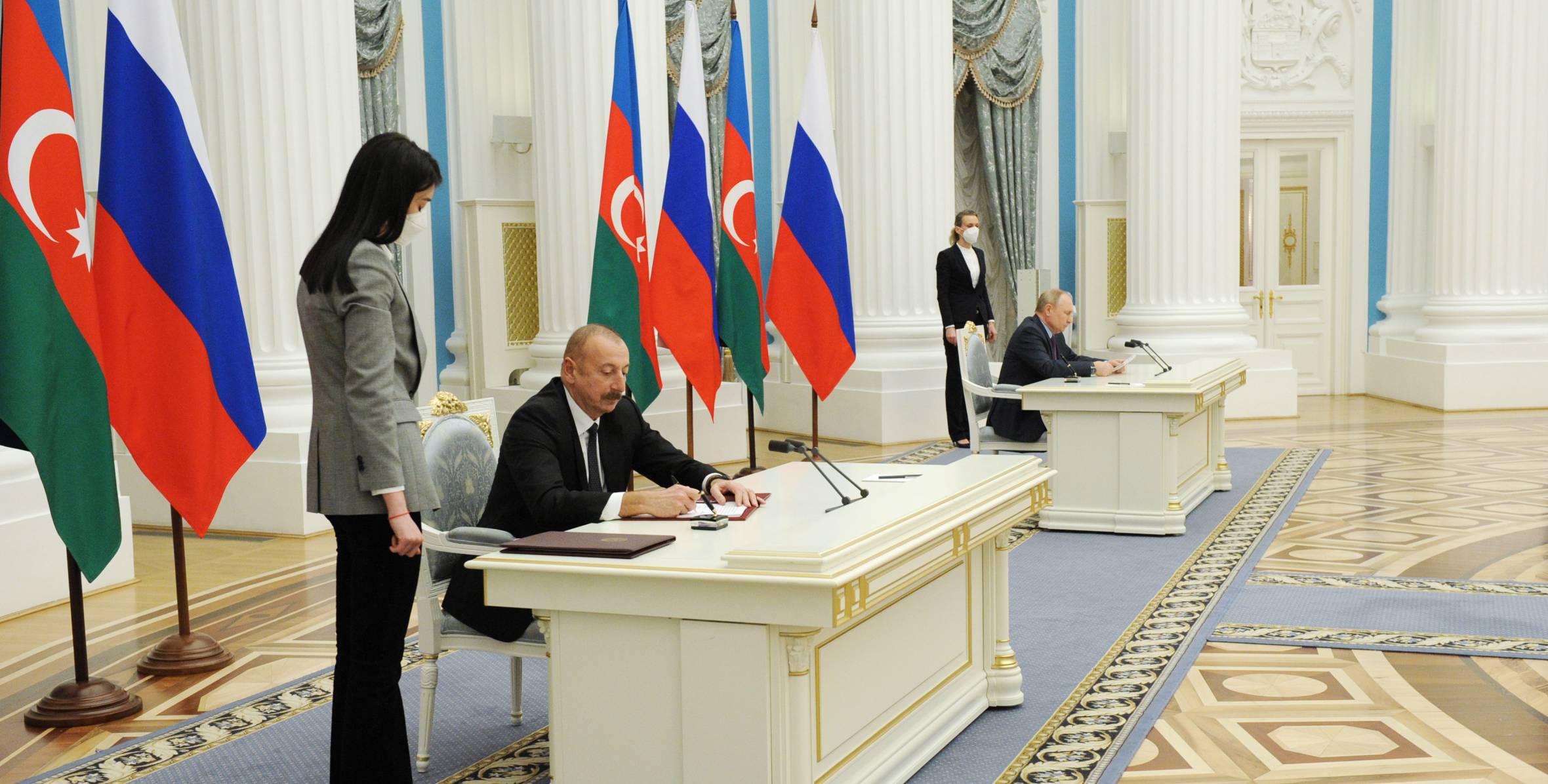
President Ilham Aliyev and President Vladimir Putin sign “Declaration on allied interaction between the Republic of Azerbaijan and the Russian Federation”, Moscow, Russia, February 22, 2022 / President.Az
On Feb. 22, Azerbaijani President Ilham Aliyev visited Moscow at the invitation of Russian President Vladimir Putin at what was a sensitive moment—just a day after Moscow officially recognized the independence of the separatist regions of Donetsk and Luhansk in eastern Ukraine and a day before Russia launched a full-scale invasion of the country.
The main agenda of Aliyev’s visit was to sign a new declaration that upgraded the two countries’ relationship to one of “allied cooperation.” The declaration expresses both sides’ intention of strengthening cooperation across a wide range of fields, including regional security issues, military ties, energy, and trade, while calling for mutual consultations on joint efforts in international organizations, with the aim “to protect the interests of Azerbaijan and Russia.” It builds on two previous agreements signed between the two countries in 1997 and 2008 that elevated their relationship to a strategic partnership.
Unsurprisingly, the timing of the declaration’s signature was poorly received in Azerbaijan, where many interpreted the document as sacrificing Baku’s long-term strategy of a balanced and independent foreign policy. It also triggered speculation and public debate at home as well as in the Russian media as to whether the move was imposed by Moscow, or whether it represented yet another pragmatic step by Baku to ensure its national interests in a rapidly changing European geopolitical environment.
From Azerbaijan’s perspective, though, the outreach to Russia should come as no surprise. Baku has long pursued a balanced foreign policy between Moscow and the West, maneuvering as best it can to prevent Azerbaijan from falling under the influence of either. Notably, the new declaration came just weeks after the European Union’s energy commissioner visited Baku seeking increased natural gas deliveries to make up for potential shortfalls in the event Russia cuts off supplies as part of the standoff over Ukraine—a request that Baku granted. Nor is this the first such allied cooperation agreement that Moscow has pursued with regional states: In 2000, Russia signed a similar document with Armenia to boost “bilateral cooperation between the two partner states in defense, economic, and social fields.”
However, the new declaration is particularly important for Azerbaijan in light of the ongoing uncertainties around Nagorno-Karabakh and the Russian peacekeeping mission deployed in the breakaway region—which is internationally recognized as Azerbaijani territory but is partly controlled by ethnic Armenians—since the cease-fire agreement that ended the most recent fighting there in November 2020. That mission still lacks a clear mandate, and although the new declaration does not directly address the issue, Baku seems to think it could eventually lead to more clarity on Russia’s role in Nagorno-Karabakh.
Though framed as an alliance, the new declaration is written in general language assuring Baku’s friendly attitude toward Russia, but falls short of outlining specific obligations for either party. For Moscow, it was likely meant to ensure that Azerbaijan abstains from Western efforts to isolate Russia, including sanctions imposed by the U.S. and the European Union, following the invasion of Ukraine.
Despite the optics of Aliyev’s visit coming against the backdrop of the invasion of Ukraine, Azerbaijan’s main concern in deepening cooperation with Moscow remains Nagorno-Karabakh.
Besides these more general points, there are also a few new articles in the document outlining closer defense and military cooperation. In practical terms, these mean that Baku will probably continue to import Russian arms, participate in joint modernization programs of certain types of Soviet-era weapons—particularly helicopters and aircraft—and cooperate with Moscow on issues related to regional security.
By signing an agreement guaranteeing its “close military partnership,” Baku also sidestepped having to join the Russia-led Collective Security Treaty Organization, or CSTO, something that Moscow has sought and Baku has avoided for many years. For Baku, joining the CSTO alongside Armenia has long been unacceptable. But membership would also bring with it some tough obligations as well as negative consequences for its relations with the West.
Upon the signing of the agreement, some critics raised concerns that Baku may also bow to Russian pressure to recognize the independence of Donetsk and Luhansk. But while Baku has so far abstained from public statements of support for Kyiv since Russia began its invasion, Azerbaijan has already made its position regarding Ukraine’s territorial integrity clear: In January, when tensions between Ukraine and Russia had peaked, Aliyev flew to Kyiv, where he and Ukrainian President Volodymyr Zelensky signed agreements for energy cooperation as well as a Joint Declaration reaffirming both sides’ readiness to, according to Zelensky, “provide mutual support for the sovereignty, territorial integrity of [their states] within internationally recognized borders.” Once the Russian invasion began, Azerbaijan quickly responded by dispatching humanitarian aid to Ukraine and agreeing to provide free fuel via its State Oil Company, SOCAR, for Ukrainian ambulances and fire engines.
Nevertheless, despite the optics of Aliyev’s visit coming against the backdrop of the invasion of Ukraine, Azerbaijan’s main concern in deepening dialogue and cooperation with Moscow remains Nagorno-Karabakh and the de facto separatist regime that still controls it on the ground. Baku insisted on including in the declaration additional points that reaffirm its stance on the region and call for unblocking regional transport linkages, such as railway connections and the Nakhchivan land corridor linking Azerbaijan to Turkey. In so doing, Baku made it clear that closer ties with Moscow would not come at the cost of its own national security interests and red lines.
The document could also be a first step toward further dialogue to establish the ground rules for the Russian peacekeeping mission stationed in Nagorno-Karabakh, with just three years left before its withdrawal, as called for in the November 2020 cease-fire agreement. In particular, Azerbaijan has its eyes on post-conflict reconstruction and a definitive political resolution of the conflict with Armenia as soon as possible, which would make the deployment of the Russian peacekeeping forces unnecessary.
The declaration’s calls for heightened defense and security cooperation notwithstanding, in all likelihood Baku will continue to rely on Turkey and Israel rather than on Russia for military support, due to their advanced military technology and the mutual trust that has developed in those bilateral relationships in the past decade through frequent joint military drills and military contracts. Azerbaijan also recently secured a comprehensive regional security partnership with Turkey—whose military support was critical to Baku’s battlefield victory against Armenian forces in the 2020 war—in the form of the Shusha declaration, which was signed in June, 2021 and recently ratified by the parliaments of both sides.
In this light, the recent declaration signed with Russia can be seen more as a guarantee of Azerbaijan’s neutrality when it comes to Moscow’s conflict with the West, rather than its support. In return, it serves as an investment toward securing Russia’s cooperation in efforts to reach a final peace agreement to resolve the Nagorno-Karabakh conflict. It reflects that, for now, Baku will continue seeking a balance between Russia and the West in order to secure its own interests. But that balance could become more difficult to maintain as Moscow becomes increasingly isolated and all regional states, including Azerbaijan, begin to feel the economic and political costs.
Fuad Shahbazov is a policy analyst covering regional security issues in the South Caucasus. He is a former research fellow at the Center for Strategic Studies of Azerbaijan and a former senior analyst at the Center for Strategic Communications, also in Azerbaijan. He has been a visiting scholar at the Daniel Morgan School of National Security in Washington. Currently, he is a master’s degree candidate in Defense and Diplomacy at the University of Durham in the U.K. He can be found on Twitter at @fuadshahbazov.
The current crisis between Russia and Ukraine has put the United States and its European allies on high alert over the possibility of the first major interstate military conflict in Europe since World War II. Although efforts to find a diplomatic resolution to the crisis continue, the room for a mutually acceptable outcome has narrowed now that the U.S. and NATO have rejected Russia’s demands that no additional NATO troops be deployed to Eastern Europe, while continuing to provide arms and other aid to Ukraine.
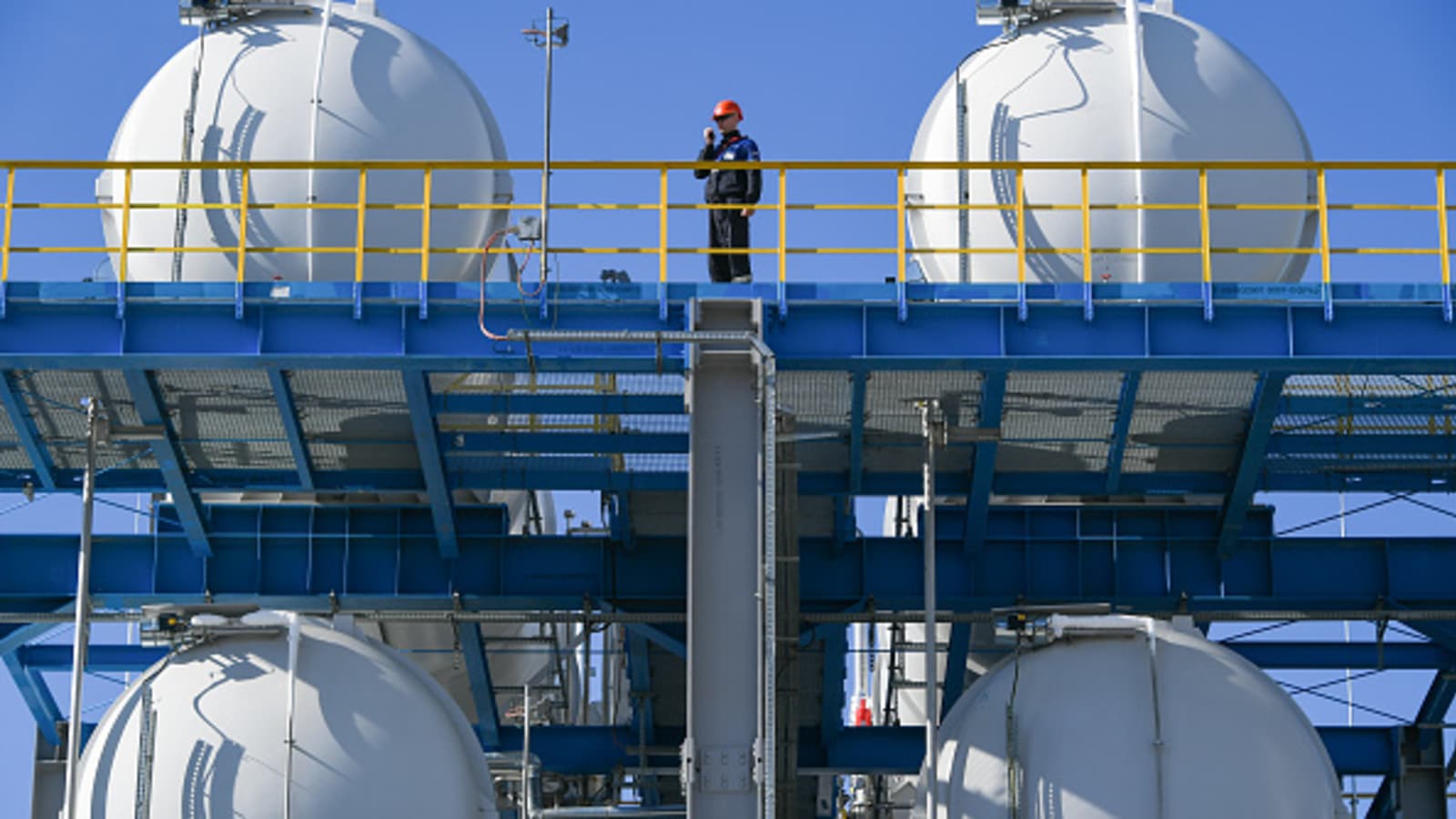
Apart from the concerns the crisis has raised over European security and Russian revanchism, Europe is also particularly alarmed about the potential for major disruptions in its energy market, which is highly dependent on Russian oil and gas. Indeed, a military invasion of Ukraine could create an energy catastrophe in Europe if it results in Russian gas exports being cut entirely. The diplomatic fallout from an invasion could also trigger the cancellation of current energy projects within the European Union, such as the Nord Stream-2 pipeline to Germany, which would have long-term implications for European energy supplies.
On October 6, 2021, Russia’s Minister of Foreign Affairs Sergei Lavrov met his Iranian counterpart Hossein Amir Abdollahian in Moscow to discuss regional security and economic cooperation, and to address important concerns regarding the crisis in the South Caucasus. During the joint press conference, Lavrov repeatedly highlighted the idea of a “3+3 cooperation format” including the three South Caucasus states – Armenia, Azerbaijan, and Georgia – plus their three large neighbors, Russia, Turkey, and Iran, to focus on unlocking economic and transport communications in the region. The first meeting within the format took place in Moscow on December 2021; however, Georgia refused to take part. Moreover, recent tensions in the region between Armenia and Azerbaijan as well as Azerbaijan and Iran suggest that the proposed format will not generate visible positive outcomes.
BACKGROUND: After the second Karabakh war, Turkey revealed its intention to establish a 3+3 cooperation format in the South Caucasus, including Azerbaijan, Armenia and Georgia along with Turkey, Russia and Iran, with the intention to boost intraregional economic cooperation and new transit links. The initiative was received positively by Russia and Iran, much less so by Georgia and Armenia given the security situation of these countries. For Armenia, participation in the format along with Azerbaijan in the aftermath of the large-scale conflict seems challenging, as Yerevan has avoided agreements on any land trade corridors with Azerbaijan as long as disagreements over borders remain unsettled. In the case of Georgia, Russia’s participation in the format spells a danger of negative repercussions.
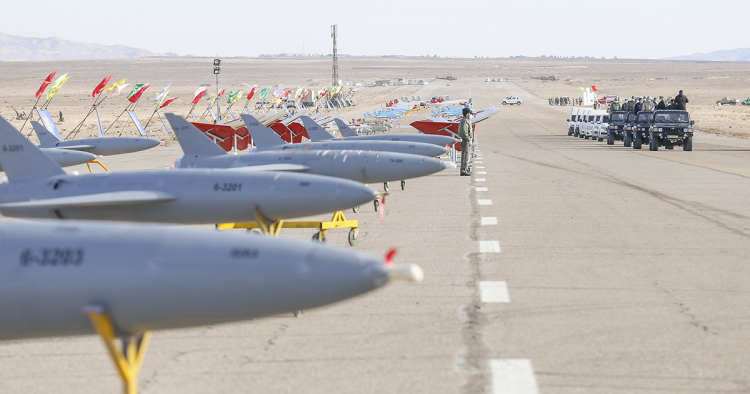
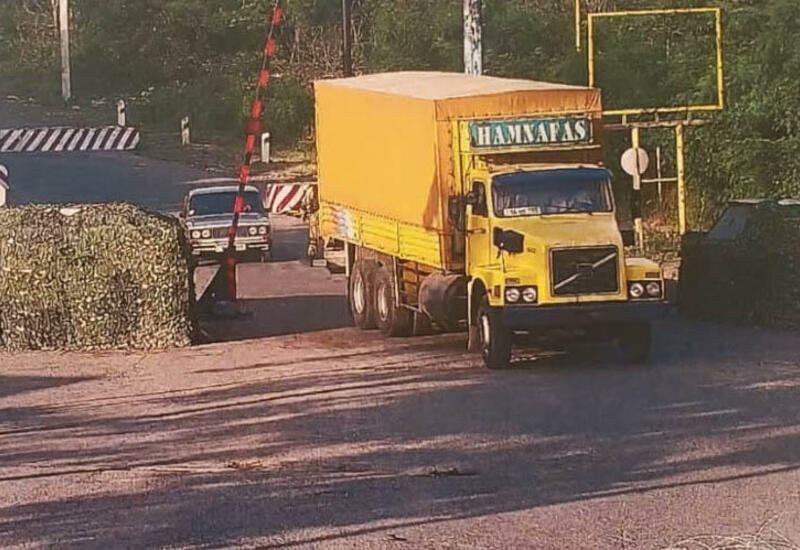
Last September, long-brewing strains between Iran and Azerbaijan reached an unprecedented level, resulting in the deployment of troops and large-scale military drills by both sides. The most immediate trigger was the Azerbaijani authorities’ arrest of two Iranian truck drivers on Armenia’s Goris–Kapan highway (which partially straddles the undelimited portion of the Armenian-Azerbaijani border) for illegally entering the territory of Azerbaijan (Turan, September 15; see EDM, October 6, 27). In addition to Baku’s and Tehran’s rival demonstrative military exercises near the two countries’ shared border, their mutual diplomatic rhetoric became even more aggressive. Inadvertently or not, Baku’s blockade of the road for Iranian trucks also notably spotlighted Iran’s energy exports to Karabakh.

_01_Cropped.jpg)